Beekeeping has a way of looking like a summer hobby and behaving like a twelve-month commitment. The colony you close up in October is the one that throws a prime swarm in May, and the queen you leave to her own devices in August is the one that leaves you with a weak, hungry cluster in February.
Dates move with the weather, the forage and the strength of the colony. A hive in Devon will be a fortnight ahead of one on a Yorkshire moor. Treat what follows as a spine for the year rather than a strict script, and let the bees tell you when they are ready.
Spring: The First Proper Look (March to April)
March is often the cruellest month for a colony. The queen starts laying, the cluster needs warmth to cover brood, and the weather can still deliver a fortnight of cold rain. On a mild afternoon you may see cleansing flights — bees taking their first proper evacuation since autumn. Resisting the urge to open the hive is usually the kindest thing you can do.
What you can do is check weight. Heft the hive from the back; if it lifts easily, they are running out of stores. Fondant placed above the crown board, directly over the cluster, will carry them through. Avoid syrup in cold weather — they cannot process it.
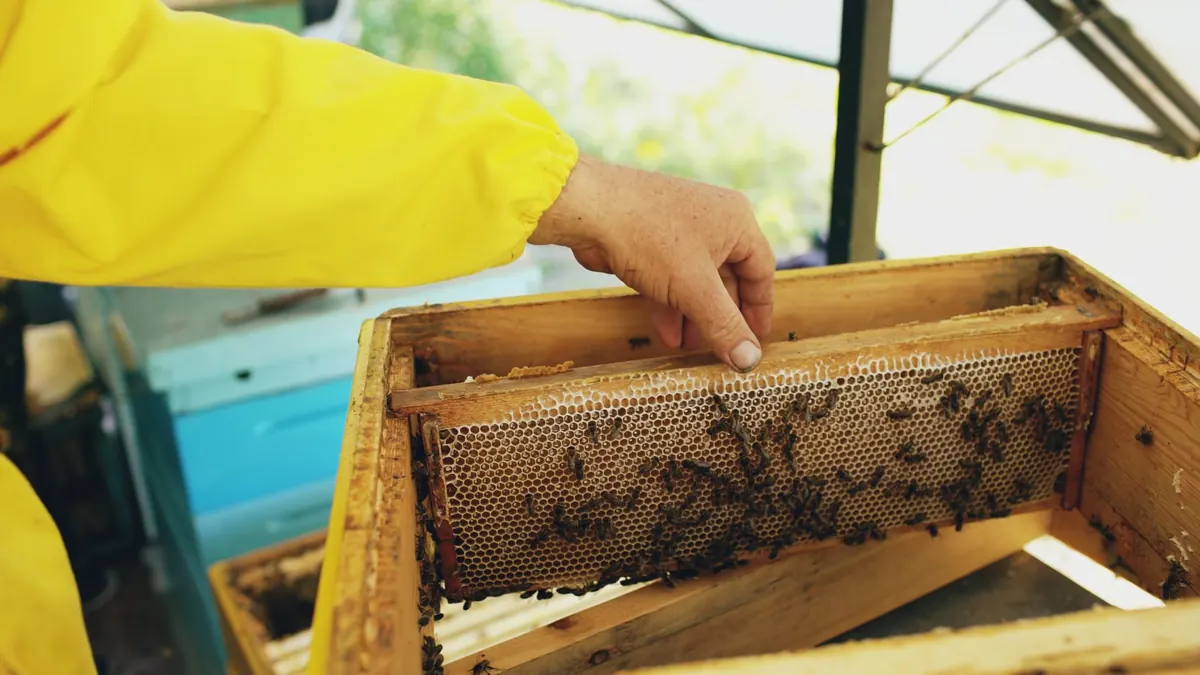
By mid-April, a dry, still day at around 14°C and above makes a full inspection worthwhile. Work from the side, keep the brood nest covered, and check for:
- Eggs and young larvae — proof the queen is present and laying
- A solid brood pattern, rather than scattered cells
- Stores and, more importantly, space to expand
- Signs of disease, damp or mould on the floor
Remove the mouse guard, clean the floor, swap out the darkest old combs and jot down what you saw. That record will be worth more than you think in July.
Late Spring: Swarm Season Begins (May to June)
From May, inspections should be weekly. Seven days sits neatly inside the window between a queen cell being started and a swarm departing, so a weekly check is your best insurance. Learn to tell the difference between an empty play cup, a charged cell with royal jelly and a larva, and a sealed cell. Once cells are sealed, the swarm can leave at almost any hour.
If you find sealed queen cells, act the same day. Common approaches include an artificial swarm, splitting the colony into a nuc, removing the queen to a spare box, or a Demaree arrangement. All of them work; the one that fails is the one you put off until next weekend. Keep a spare nuc box, brood box and frames ready so you are never improvising with wet kit in a thunderstorm.
Give them room before they ask
A colony that runs out of space puts its energy into swarming rather than honey. Add supers early, before every frame is drawn and full. A bait hive with a little old comb and a drop of lemongrass oil in a sunny spot may also catch you a free colony from someone else's neglect.
High Summer: The Honey Flow (July to August)
This is the part everyone pictures, and it is mostly about timing and tidiness. Clear supers with a clearing board or bee escapes rather than shaking every frame, and only take honey that is properly capped — uncapped honey is unripe and can ferment in the jar.
Leave the colony with enough stores to see it through the next few weeks. If the flow stops and the brood box is light, feed. August brings wasps, and a weak colony can be robbed out in an afternoon: narrow the entrance, clear up spilled honey, keep sticky supers indoors and avoid leaving frames lying about the apiary.
Late summer is also the moment to check varroa levels, using a sugar roll, an alcohol wash or a sticky board, so that any treatment later is a response to a number rather than a habit.
Autumn: Building a Colony That Survives (September to October)
Once the supers are off, treat for varroa according to your monitoring and the product instructions. Always follow the label and current UK guidance, and never treat with honey supers in place.
Feeding comes next. Thick syrup — roughly two parts sugar to one part water by weight — is what they need to cap and store, and it should go on early enough that they can still work it in warm weather. If stores are already good, leave them alone.
Then tidy up the colony itself:
- Unite weak colonies — a small cluster in October is a gamble, not a hive
- Fit mouse guards and reduce entrances
- Secure roofs with straps if the site is exposed
- Raise the hive slightly on a stand and keep grass and weeds cut back
Aim for a colony going into winter with a young queen, plenty of stores, and no more space than the bees can keep warm.
Winter: Quiet, But Not Idle (November to February)
Leave them alone. Every unnecessary inspection costs warmth, propolis and disturbance at a time when the cluster can ill afford it. Heft the hive once a month; if it feels light, slide fondant over the cluster and walk away.
Clear dead bees and snow from the entrance. Check the roof and stand after gales. Around midwinter, when the colony is usually broodless, some beekeepers treat for varroa with oxalic acid — only within the product licence and current UK rules, and only if you are confident in the method.
By February the queen is laying again and stores burn faster. A colony can starve with food in the hive if the cluster is stuck on one side of it, so keep fondant within reach. Use the quiet weeks to clean spare kit, repair frames and plan the season ahead.
The Checklist at a Glance
- January: Heft, clear entrances, repair equipment
- February: Fondant if light, watch for cleansing flights
- March: Quick look on a mild day, feed if needed
- April: Full inspections, remove mouse guards, clean floors
- May: Weekly checks for queen cells begin
- June: Swarm control, keep supers coming
- July: Extract the main crop, leave enough behind
- August: Monitor varroa, guard against wasps
- September: Treat for varroa, start autumn feeding
- October: Finish feeding, unite weak colonies, mouse guards
- November: Insulate and strap down, then leave them be
- December: Heft, shelter from storms, plan next year
Make the Checklist Yours
Two hives a mile apart can be at different stages, so use local knowledge as well as the calendar. Your association, an experienced neighbour or the National Bee Unit's BeeBase will tell you what is flying and flowering near you, and BeeBase is also where to check the rules on notifiable diseases. If you suspect foulbrood, do not wait and see — report it.
Write down what you did and when you did it, even if it is three lines on the lid of the hive. A year from now those notes will tell you more about your bees than any book. And if a task slips by a week, do not panic. Bees have been managing without us for a very long time.
Photo: Vitaly Gariev / Pexels